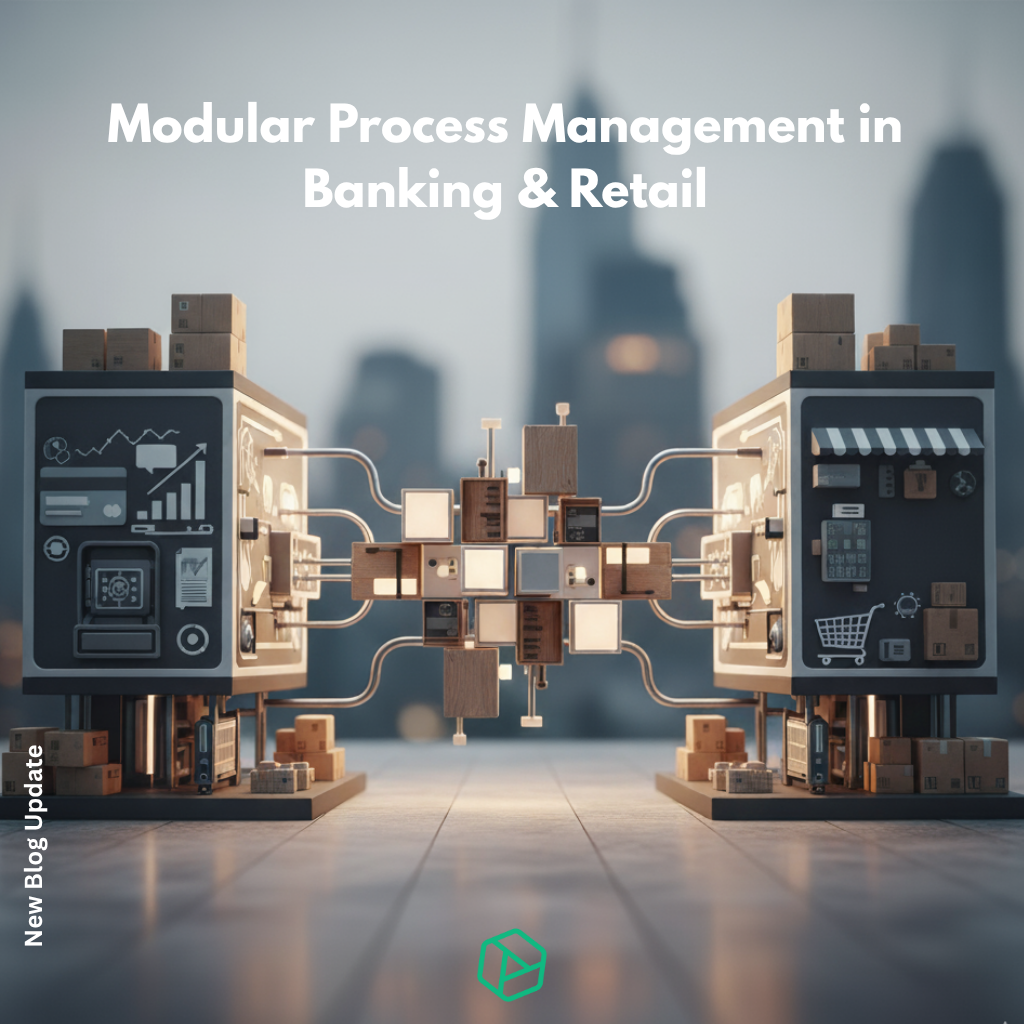
In today’s business landscape, speed isn’t just an expectation — it’s often the competition itself. Especially in sectors like banking and retail, where competition is intense and customer expectations are high, forcing operational workflows into a single rigid mold becomes increasingly risky.
Here’s today’s reality:
Business processes are not static — they’re constantly changing.
That’s why organizations are shifting toward a modular process management approach: a structure that can reshape itself as needs evolve.
So, what does this approach bring to banking and retail?
Both banks and retailers must manage a wide range of scenarios under one roof:
In banking: loan applications, fraud investigations, customer onboarding
In retail: inventory management, in-store service requests, supply chain workflows
Trying to force all these flows into the same rigid structure is clumsy and error-prone.
A modular approach allows each process to be designed based on its own needs. You don’t have to rebuild the entire system to change one step — small adjustments create big adaptability.
One of the biggest challenges in both sectors is the fragmented nature of operations — teams living in separate systems.
In banks: IT, operations, call centers, and compliance teams usually work on different platforms. In retail: store personnel, warehouse teams, procurement, and customer experience often operate in separate tools.
Modular process management brings these fragmented structures together. Teams can participate in the same process with different roles; information flow becomes clearer and more visible. It becomes instantly obvious where delays occur, who is overloaded, and which step is stuck.
In banking, constantly changing regulations require processes to adapt quickly.
Modular structures make these updates possible in hours, not weeks.
In retail, audits often focus on operational standards. Modular templates help standardize in-store processes, making audit transitions smoother and cleaner.
A customer onboarding flow that feels different at two branches damages trust in a bank. In retail, a return process that varies from store to store creates the same problem.
Modular process management helps create consistency while still allowing local flexibility:
Every touchpoint delivers the same quality, while frontline teams don’t feel constrained.
When processes are designed modularly, every step becomes easier to measure:
In high-volume sectors like banking and retail, this visibility directly impacts operational costs.
Rebuilding an entire process from scratch is overwhelming. A modular approach lets you manage change in small pieces:
It delivers quick wins and lowers organizational resistance to change.
While sectors talk about the advantages of modular process management, the real differentiator is having an infrastructure that can actually deliver this flexibility. Many organizations still need developers, extensive analysis, and weeks of testing just to make a small change. Modern process management shouldn’t work this way.
DCase’s Modular Architecture approach makes every advantage above achievable in practice.
This architecture transforms processes from large, rigid systems into independent yet compatible “building blocks.” This gives organizations three major strengths:
Regulatory updates, operational changes, in-store policy adjustments…
No matter the process, DCase’s modular structure enables you to:
all within hours. This speed is especially valuable in heavily regulated sectors like banking.
Instead of forcing processes into a one-size-fits-all model, modular architecture allows teams to tailor workflows to their needs.
IT, operations, store staff, or call centers — each works only within the modules relevant to their role. This reduces complexity and boosts efficiency.
In banking (loan, onboarding), and in retail (inventory, supply chain, store operations), each workflow shares common building blocks.
With DCase’s modular approach:
Processes don’t become more complicated as they grow — they become more manageable.
In speed-, trust-, precision-, and experience-focused sectors like banking and retail, modular process management is no longer optional — it’s the foundation of sustainable growth.
This approach enables organizations to become:
DCase’s Modular Architecture accelerates and simplifies this transformation. It turns processes into structures that don’t become heavier as they scale — they become stronger.